
Facial Recognition: The Privacy Battle We Can’t Afford to Lose
Facial recognition technology, once considered science fiction, has become a pervasive tool in the modern world. This technology identifies or verifies individuals by analyzing unique facial features. Its capabilities have expanded rapidly, impacting various aspects of daily life.
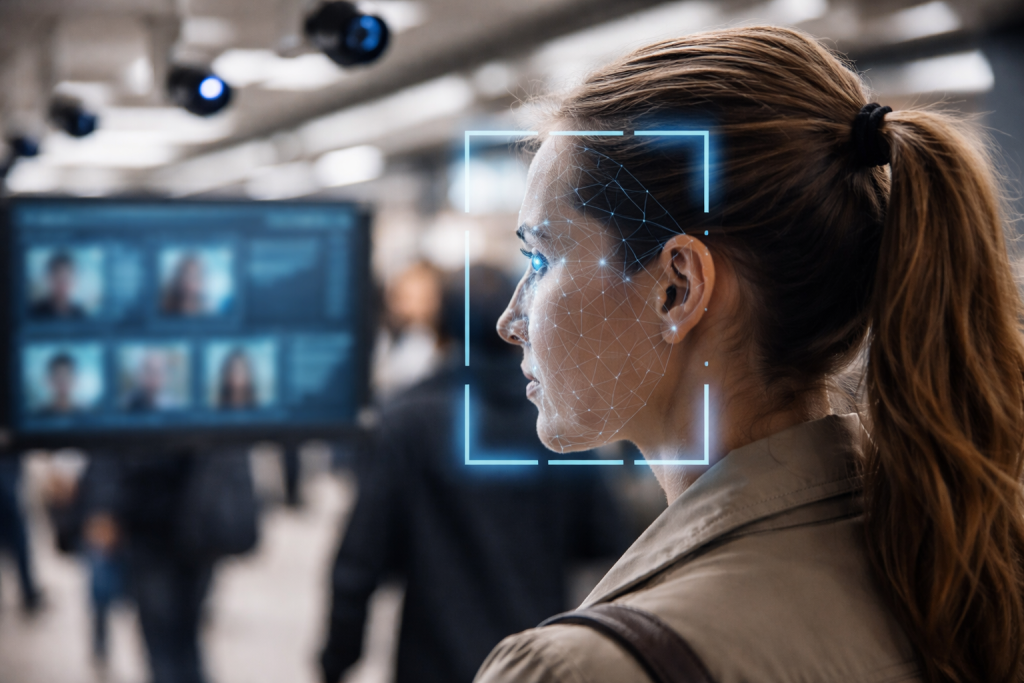
The origins of facial recognition trace back to the 1960s with early attempts at automated facial identification. These initial efforts involved manually marking facial landmarks and comparing them to a database. As computing power advanced, so did the sophistication of these systems.
Contents
- 0.1 Early Developments
- 0.2 Modern Advancements and Applications
- 0.3 Data Security and Misuse
- 0.4 Bias and Discrimination
- 0.5 Law Enforcement and Surveillance
- 0.6 Commercial Applications
- 0.7 Lack of Comprehensive Legislation
- 0.8 Debates on Consent and Surveillance
- 0.9 Erosion of Anonymity
- 0.10 Potential for Discrimination and Profiling
- 0.11 Chilling Effect on Free Speech and Assembly
- 0.12 Public Awareness Campaigns
- 0.13 Legal Challenges and Lobbying Efforts
- 0.14 Policy Proposals and Moratoriums
- 0.15 Seeking a Middle Ground
- 0.16 The Need for International Cooperation
- 0.17 Empowering Individuals
- 1 FAQs
- 1.1 What is facial recognition technology?
- 1.2 What are the privacy concerns and ethical issues surrounding facial recognition technology?
- 1.3 How is facial recognition technology being used by governments and corporations?
- 1.4 What legal and regulatory challenges exist in the use of facial recognition technology?
- 1.5 What is the future of facial recognition technology and how can security and privacy be balanced?
Early Developments
Throughout the 1970s and 1980s, research focused on geometric approaches, mapping distances and ratios between key facial points. These systems were often limited by variations in pose, lighting, and expression. The performance was rudimentary compared to today’s standards, but they laid the groundwork for future advancements.
Modern Advancements and Applications
The 21st century brought a significant leap forward with the advent of deep learning and artificial intelligence. These new techniques allow systems to learn from vast datasets of images, recognizing patterns that human programmers could not explicitly define. This has led to dramatic improvements in accuracy and speed.
Today, facial recognition is integrated into a multitude of applications. You likely encounter it daily when unlocking your smartphone, tagging friends in social media photos, or navigating airport security. Law enforcement utilizes it for identifying suspects and locating missing persons. Retailers use it to track customer behavior and deter shoplifting. This proliferation highlights its versatility but also raises concerns about its impact on individual privacy.
The widespread deployment of facial recognition technology has ignited a debate about privacy and ethical implications. If your face is a key, unlocking access to your identity and personal data, then the widespread deployment of this technology means many entities now hold copies of your key.
Data Security and Misuse
A primary concern is the security of facial data. These unique biometric identifiers, once collected, can be stored in databases. If these databases are breached, your facial data could be compromised, leading to identity theft or other forms of misuse. Unlike a stolen password, you cannot simply change your face.
Furthermore, the potential for misuse by legitimate entities is substantial. Consider a scenario where facial recognition is used to create detailed profiles of individuals, tracking their movements, spending habits, and even emotional states. This information could be exploited for targeted advertising, discriminatory practices, or even political manipulation.
Bias and Discrimination
Another critical ethical issue is bias. Facial recognition algorithms can exhibit bias due to the datasets they are trained on. If a dataset disproportionately represents certain demographics, the system may perform less accurately on others. This can lead to higher error rates for women, people of color, and other minority groups.
Such bias can have severe consequences, particularly in law enforcement applications. Misidentification can lead to wrongful arrests, disproportionately affecting vulnerable populations. The implicit biases encoded in these systems can perpetuate and amplify existing societal inequalities.
The adoption of facial recognition by both government agencies and private corporations has expanded significantly. Each sector employs the technology for distinct purposes, but the underlying mechanisms and potential impacts converge.
Law Enforcement and Surveillance
Governments worldwide use facial recognition for public safety, national security, and border control. Police forces employ it to identify individuals from surveillance footage, compare faces to watchlists, and assist in criminal investigations. This capability offers a powerful tool for crime solving, but it also opens the door to widespread public surveillance.
The deployment of pervasive surveillance networks, where cameras equipped with facial recognition are ubiquitous, could lead to a constant state of monitoring. This shifts the balance of power, creating an environment where individuals are always being watched, potentially chilling free speech and assembly. The street becomes an open book, its passages readable by anyone with the right technology.
Commercial Applications
Corporations leverage facial recognition for a range of commercial objectives. Retailers use it to improve customer service, analyze foot traffic, and detect known shoplifters. Social media platforms employ it for photo tagging and personalization. Financial institutions use it for identity verification and fraud prevention.
While some applications offer convenience and security benefits, others raise questions about commercial exploitation of personal data. The collection of facial data for marketing purposes, for instance, allows companies to build detailed profiles of consumers without explicit consent, influencing purchasing decisions and potentially exploiting vulnerabilities.
The rapid advancement and deployment of facial recognition technology have outpaced the development of comprehensive legal frameworks to govern its use.
Lack of Comprehensive Legislation
Currently, there is no overarching federal law in many countries specifically addressing facial recognition. Existing privacy laws, such as the General Data Protection Regulation (GDPR) in Europe, offer some protections for biometric data, but their application to facial recognition can be complex and inconsistent. The United States, for example, has a patchwork of state and local laws, creating an uneven regulatory landscape.
This lack of clear legal boundaries leaves room for ambiguity and potential overreach. Without specific regulations, the lines between legitimate use and privacy infringement can blur, making it difficult for individuals to understand their rights or seek redress.
Debates on Consent and Surveillance
A central debate revolves around consent. Should individuals explicitly consent to having their faces collected and analyzed? The nature of public spaces makes obtaining individual consent practically challenging for widespread surveillance systems. If a public park is under facial recognition surveillance, is merely entering the park considered implicit consent?
Another critical area of discussion concerns the legality of government surveillance without warrants. While law enforcement typically requires a warrant to search a home, the “public space doctrine” has often allowed surveillance in public areas without such requirements. However, facial recognition transforms public spaces into highly identifiable zones, fundamentally altering the nature of public interaction and anonymity.
The widespread use of facial recognition poses a significant threat to fundamental civil liberties, potentially reshaping the fabric of democratic societies.
Erosion of Anonymity
The ability to move through public spaces anonymously is a cornerstone of free societies. Facial recognition erodes this anonymity, transforming public areas into zones where every individual can be identified and tracked. This constant surveillance can have a chilling effect, deterring individuals from participating in protests, expressing dissident views, or engaging in activities that might draw unwanted attention. The public square, once a canvas for diverse expression, risks becoming a monitored stage.
Potential for Discrimination and Profiling
As discussed, algorithmic bias can lead to discriminatory outcomes. If facial recognition systems are used for predictive policing or to identify individuals deemed “suspicious,” they could exacerbate existing biases in law enforcement and lead to disproportionate scrutiny of certain communities. This creates a feedback loop where biased data leads to biased outcomes, reinforcing social inequalities.
Chilling Effect on Free Speech and Assembly
The awareness of constant surveillance can deter individuals from exercising their rights to free speech and peaceful assembly. If participating in a protest means being identified, recorded, and potentially added to a government watchlist, many may choose to self-censor or avoid public demonstrations altogether. This undermines the democratic process by hindering the ability of citizens to collectively voice their concerns and hold power accountable.
In the face of these challenges, activism and advocacy groups have become crucial in pushing for greater accountability and regulation of facial recognition technology.
Public Awareness Campaigns
Advocates work to educate the public about the capabilities and risks of facial recognition. Through reports, documentaries, and social media campaigns, they aim to demystify the technology and highlight its potential impacts on privacy and civil liberties. Informed citizens are better equipped to demand protections and influence policy decisions.
Legal Challenges and Lobbying Efforts
Civil liberties organizations have launched legal challenges against government and corporate entities using facial recognition without adequate safeguards. These lawsuits aim to establish legal precedents and force stricter adherence to privacy principles. Simultaneously, lobbying efforts target legislators to enact stronger laws and regulations that restrict the deployment and use of the technology.
Policy Proposals and Moratoriums
Activists have proposed various policy solutions, including outright bans on certain uses of facial recognition, stricter consent requirements, and independent oversight mechanisms. Several cities and states have already implemented moratoriums or outright bans on government use of facial recognition, demonstrating the power of grassroots movements to effect change. This marks a first important step, like building a fence around a garden to protect it from invasive species.
The trajectory of facial recognition is an ongoing negotiation between competing values. The pursuit of enhanced security and convenience clashes with the fundamental right to privacy and civil liberties.
Seeking a Middle Ground
Finding a sustainable path forward requires a nuanced approach. It is unlikely that outright bans will fully halt the development or use of this powerful technology. Instead, the focus must shift towards establishing robust frameworks that allow for responsible use while mitigating risks. This includes transparent deployment policies, independent auditing of algorithms for bias, and strong accountability mechanisms.
The Need for International Cooperation
Given the global nature of technology and data flows, international cooperation is essential. Different countries adopting vastly different regulations could create regulatory arbitrage, where entities move their operations to jurisdictions with less stringent rules. Harmonized standards and shared best practices can help create a more consistent and effective protective environment.
Empowering Individuals
Ultimately, the future of facial recognition depends on empowering individuals. This means providing clear information about how their facial data is collected and used, offering accessible avenues for redress, and giving them greater control over their biometric information. Your face is your identity; the power to control its use is a fundamental dimension of personal autonomy. The battle for privacy in the age of facial recognition is a critical one, and its outcome will shape the kind of society we inhabit.
FAQs
What is facial recognition technology?
Facial recognition technology is a biometric software application capable of identifying or verifying a person from a digital image or a video frame from a video source. It works by comparing selected facial features from the image and a facial database.
What are the privacy concerns and ethical issues surrounding facial recognition technology?
Privacy concerns and ethical issues surrounding facial recognition technology include the potential for mass surveillance, invasion of privacy, misuse of personal data, and the lack of consent from individuals being monitored or identified.
How is facial recognition technology being used by governments and corporations?
Governments and corporations are using facial recognition technology for various purposes, including law enforcement, border control, surveillance, access control, marketing, and customer service. This technology is also being used in public spaces, airports, and commercial establishments.
What legal and regulatory challenges exist in the use of facial recognition technology?
Legal and regulatory challenges in the use of facial recognition technology include issues related to data protection, consent, transparency, accuracy, bias, discrimination, and the need for clear guidelines and regulations to govern its use.
What is the future of facial recognition technology and how can security and privacy be balanced?
The future of facial recognition technology involves finding a balance between security and privacy through the development of robust regulations, ethical guidelines, and technological advancements that prioritize the protection of civil liberties and individual rights while addressing security concerns.

AI & Secure is dedicated to helping readers understand artificial intelligence, digital security, and responsible technology use. Through clear guides and insights, the goal is to make AI easy to understand, secure to use, and accessible for everyone.