
Demystifying the Future of Artificial Intelligence: What You Need to Know
Contents
- 1 Demystifying the Future of Artificial Intelligence
- 1.1 Machine Learning: The Engine of AI Growth
- 1.2 Deep Learning: Mimicking the Brain’s Structure
- 1.3 Natural Language Processing (NLP): Understanding Human Language
- 1.4 Healthcare: Diagnosing and Discovering
- 1.5 Finance: Managing Risk and Personalizing Services
- 1.6 Manufacturing: Optimizing Production and Supply Chains
- 1.7 Retail: Personalizing Experiences and Automating Operations
- 1.8 Transportation: Enhancing Safety and Efficiency
- 1.9 Bias in AI: Reflecting Societal Flaws
- 1.10 Transparency and Explainability: Understanding the “Why”
- 1.11 Accountability and Responsibility: Who IsIs to Blame?
- 1.12 Privacy Concerns: Data as a Double-Edged Sword
- 1.13 Automation and Augmentation: Redefining Tasks
- 1.14 The Rise of New Roles and Skill Requirements
- 1.15 Lifelong Learning and Adaptability: Embracing Change
- 1.16 Myth: AI Will Imminently Become Sentient or Conscious
- 1.17 Myth: AI Will Take All Our Jobs
- 1.18 Myth: AI is Inherently Evil or Dangerous
- 1.19 Understanding the Basics for Informed Decision-Making
- 1.20 Empowering Individuals and Society
- 1.21 Opportunities for Innovation and Progress
- 1.22 The Need for Careful Governance and Collaboration
- 2 FAQs
Demystifying the Future of Artificial Intelligence
Artificial intelligence, often shortened to AI, represents a broad field of computer science concerned with building smart machines capable of performing tasks that typically require human intelligence. This encompasses learning, problem-solving, perception, and decision-making. AI systems are not inherently conscious or sentient; rather, they are designed to process information and act upon it in ways that mimic intelligent behavior. The development of AI has a long history, with foundational concepts emerging decades ago, but recent advancements in computing power, data availability, and algorithmic techniques have propelled AI into widespread practical application.
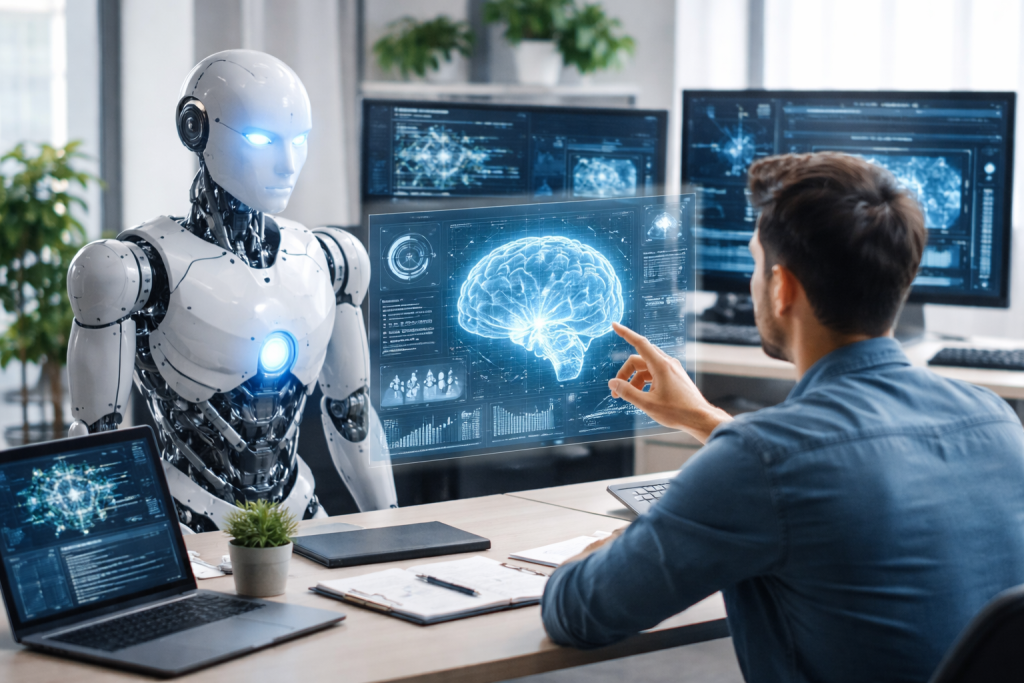
At its core, artificial intelligence relies on algorithms and data. Algorithms are sets of rules or instructions that computers follow to perform specific tasks. In AI, these algorithms are designed to learn from data. This learning process can take various forms, each suited to different types of problems.
Machine Learning: The Engine of AI Growth
Machine learning (ML) is a subfield of AI that enables systems to learn from data without being explicitly programmed. Instead of writing specific instructions for every possible scenario, developers create algorithms that can identify patterns, make predictions, and improve their performance over time as they are exposed to more data. Think of it as teaching a child by showing them many examples. The more examples they see, the better they become at recognizing and understanding new ones.
Supervised Learning
In supervised learning, algorithms are trained on a labeled dataset, meaning each data point has a corresponding correct output. For instance, to train a spam email detector, the algorithm would be fed thousands of emails, each clearly marked as “spam” or “not spam.” The algorithm learns to associate certain words, phrases, and patterns with spam and then uses this knowledge to classify new, unseen emails.
Unsupervised Learning
Unsupervised learning operates on unlabeled data. The algorithm’s task is to find hidden patterns or structures within the data itself. This is useful for tasks like customer segmentation, where a business might use unsupervised learning to group customers with similar purchasing behaviors without predefining those groups. It’s like sorting a mixed box of toys into piles based on their similarities without being told what each pile should represent.
Reinforcement Learning
Reinforcement learning involves an agent that learns by interacting with an environment. The agent receives rewards for desirable actions and penalties for undesirable ones. Through trial and error, the agent learns to optimize its actions to maximize its cumulative reward. This is similar to teaching a pet a new trick; you reward them when they get it right and correct them when they make a mistake. This approach is behind much of the progress seen in AI playing complex games like chess and Go.
Deep Learning: Mimicking the Brain’s Structure
Deep learning is a subset of machine learning that uses artificial neural networks with multiple layers (hence “deep”). These networks are loosely inspired by the structure and function of the human brain. Each layer in a neural network processes information and passes it to the next layer, progressively extracting more complex features from the data.
Neural Networks
Artificial neural networks consist of interconnected nodes, or “neurons,” organized in layers. The connections between neurons have associated weights, which are adjusted during the learning process. When data is fed into the network, it passes through these layers, with each neuron performing a calculation and passing its output to the next. The network “learns” by modifying these weights to improve its accuracy in performing a given task. Deep learning models, with their many layers, can learn highly abstract representations of data, making them powerful for tasks like image recognition and natural language understanding.
Natural Language Processing (NLP): Understanding Human Language
Natural language processing (NLP) is a branch of AI focused on enabling computers to understand, interpret, and generate human language. This is a complex endeavor, as human language is filled with nuance, context, idioms, and sarcasm.
Understanding and Generation
NLP systems can be used for a variety of applications, including sentiment analysis (determining the emotional tone of text), machine translation, text summarization, and chatbots. The ability of AI to understand and generate human language is a critical step toward more natural and intuitive human-computer interaction.
Artificial intelligence is no longer a theoretical concept; it is actively reshaping industries worldwide. Its ability to process vast amounts of data, identify patterns, and automate complex tasks is driving innovation and efficiency.
Healthcare: Diagnosing and Discovering
In healthcare, AI is being deployed to improve diagnostics, personalize treatment plans, and accelerate drug discovery. AI algorithms can analyze medical images like X-rays and MRIs with remarkable accuracy, sometimes identifying subtle indicators of disease that a human eye might miss. This can lead to earlier detection and intervention. Furthermore, AI can sift through massive datasets of patient information and research papers to identify potential new treatments or predict how a patient might respond to a particular medication. Think of AI as a tireless medical assistant, poring over data to find answers.
Finance: Managing Risk and Personalizing Services
The financial sector leverages AI for fraud detection, algorithmic trading, credit scoring, and customer service. AI systems can monitor transactions in real-time, flagging suspicious activities that deviate from normal patterns, thereby preventing financial losses. In trading, AI can analyze market trends and execute trades at speeds impossible for humans. For customers, AI-powered chatbots and personalized recommendation engines are enhancing user experience and providing tailored financial advice.
Manufacturing: Optimizing Production and Supply Chains
AI is revolutionizing manufacturing through predictive maintenance, quality control, and supply chain optimization. By analyzing sensor data from machinery, AI can predict when equipment is likely to fail, allowing for proactive maintenance and minimizing downtime. AI-powered vision systems can inspect products for defects with greater consistency than human inspectors. In supply chains, AI can optimize logistics, forecast demand, and manage inventory more efficiently, ensuring that goods reach their destinations on time and with minimal waste.
Retail: Personalizing Experiences and Automating Operations
The retail industry benefits from AI through personalized recommendations, inventory management, and enhanced customer service. AI algorithms analyze purchasing history and browsing behavior to offer tailored product suggestions to customers, increasing sales and satisfaction. For businesses, AI can optimize stock levels, forecast demand for specific products, and automate aspects of inventory management. AI-powered chatbots can handle customer inquiries, freeing up human staff for more complex issues.
Transportation: Enhancing Safety and Efficiency
AI is a driving force behind advancements in autonomous vehicles, traffic management, and logistics. The development of self-driving cars relies heavily on AI for perception, decision-making, and control. AI algorithms can also optimize traffic flow in urban environments, reducing congestion and travel times. In logistics, AI helps manage fleets of vehicles, plan optimal routes, and predict delivery times more accurately.
As AI systems become more sophisticated and integrated into our lives, ethical considerations take center stage. It is crucial to develop and use AI responsibly to maintain public trust and mitigate potential harms.
Bias in AI: Reflecting Societal Flaws
AI systems learn from data, and if that data reflects existing societal biases, the AI will inherit them and potentially amplify them. For example, an AI trained on historical hiring data that favors certain demographics might perpetuate discriminatory practices. Developers must actively work to identify and mitigate bias in datasets and algorithms. Such an effort is like ensuring a mirror reflects an accurate, unmarred image, rather than a distorted one.
Transparency and Explainability: Understanding the “Why”
Many advanced AI models, particularly deep learning networks, operate as “black boxes,” meaning it can be difficult to understand precisely why they arrive at a particular decision. This lack of transparency can be problematic, especially in critical applications like medical diagnosis or legal judgments. Research into explainable AI (XAI) aims to make AI decisions more understandable to humans.
Accountability and Responsibility: Who IsIs to Blame?
When an AI system makes a mistake or causes harm, determining accountability can be complex. Is the developer responsible? The user? The company that deployed the AI? Establishing clear lines of responsibility is essential for both legal and ethical reasons.
Privacy Concerns: Data as a Double-Edged Sword
AI systems often require vast amounts of data to function effectively, raising significant privacy concerns. We must handle the collection, storage, and use of personal data with utmost care and in compliance with privacy regulations. It is still hard to find a balance between the benefits of AI and the right to privacy.
The integration of AI into the workplace is transforming job roles and the very nature of work itself. While some jobs may become automated, new opportunities and demands for different skill sets are emerging.
Automation and Augmentation: Redefining Tasks
AI is increasingly automating repetitive and data-intensive tasks, allowing human workers to focus on more creative, strategic, and interpersonal aspects of their jobs. AI can act as a powerful tool that augments human capabilities, rather than simply replacing them. Imagine AI as the advanced tools of a skilled craftsman, empowering them to achieve greater precision and efficiency in their work.
The Rise of New Roles and Skill Requirements
As AI takes over certain tasks, there will be a growing demand for individuals who can develop, manage, and work alongside AI systems. This includes AI trainers, data scientists, AI ethicists, and prompt engineers. The need for critical thinking, creativity, problem-solving, and emotional intelligence will likely increase.
Lifelong Learning and Adaptability: Embracing Change
The rapid pace of AI development necessitates a commitment to lifelong learning and adaptability. Workers will need to continuously acquire new skills and update their knowledge to remain relevant in an evolving job market. Educational institutions and employers will play a vital role in providing pathways for reskilling and upskilling.
The rapid ascent of AI has also led to the proliferation of sensationalized claims and misconceptions. Understanding what AI is and what it is not is essential for a balanced perspective.
Myth: AI Will Imminently Become Sentient or Conscious
While AI can perform incredibly complex tasks, current AI systems are not sentient or conscious in the way humans are. They do not experience emotions, have self-awareness, or possess subjective experiences. True artificial general intelligence (AGI), which surpasses human cognitive abilities in all aspects, and artificial superintelligence (ASI) remain a distant prospect.
Myth: AI Will Take All Our Jobs
AI will undoubtedly automate many tasks, leading to shifts in the job market. However, history shows that technological advancements often create more new jobs than they eliminate. The focus will shift from performing routine tasks to managing, designing, and collaborating with AI. The economic landscape will change, but outright widespread job elimination is not the immediate or most likely outcome.
Myth: AI is Inherently Evil or Dangerous
AI is a tool, and like any tool, its impact depends on how it is designed and used. The dangers associated with AI stem from human decisions regarding its development and deployment, particularly concerning bias, misuse, and a lack of ethical oversight. Responsible development and governance are key to ensuring AI benefits humanity.
As AI becomes more pervasive, a basic understanding of its principles and implications is becoming increasingly important for everyone. AI literacy is not just for technologists; it’s for citizens.
Understanding the Basics for Informed Decision-Making
A foundational understanding of AI allows individuals to engage in informed discussions about its societal impact, critically evaluate news and claims about it, and make sound personal and professional decisions in an AI-influenced world. Imagine being able to navigate a complex landscape without a map; AI literacy provides that map.
Empowering Individuals and Society
Equipping people with AI knowledge empowers them to harness its benefits, mitigate its risks, and participate in shaping its future. Educational initiatives, from schools to public awareness campaigns, are necessary to encourage this widespread literacy.
The future of artificial intelligence is brimming with potential but also presents significant hurdles that must be addressed to realize its full, positive impact.
Opportunities for Innovation and Progress
The opportunities presented by AI are vast. It holds the promise of solving some of humanity’s most pressing challenges, from climate change and disease to poverty and resource scarcity. AI can accelerate scientific discovery, drive economic growth, and improve the quality of life for people around the globe.
The Need for Careful Governance and Collaboration
A concerted effort involving researchers, policymakers, industry leaders, and the public is required to navigate the challenges. Establishing robust governance frameworks, promoting international collaboration, and prioritizing ethical considerations will be essential to ensure that AI develops in a way that benefits all of humanity. We are actively shaping the future of AI.
FAQs
1. What is Artificial Intelligence (AI), and how does it work?
Artificial Intelligence (AI) refers to the simulation of human intelligence in machines that are programmed to think and act like humans. This includes tasks such as learning, problem-solving, and decision-making. AI works by using algorithms and data to analyze patterns, make predictions, and continuously improve its performance.
2. How is AI impacting different industries?
AI is transforming various industries such as healthcare, finance, manufacturing, and transportation by automating processes, improving efficiency, and enabling better decision-making. Healthcare uses AI for disease diagnosis and personalized treatment plans, while finance uses it for fraud detection and risk assessment.
3. What are the ethical considerations in AI development?
Ethical considerations in AI development include issues related to privacy, bias, transparency, and accountability. It is important to ensure that AI systems are developed and used in a way that respects human rights, promotes fairness, and minimizes potential harm to individuals and society.
4. How is AI shaping the future of work?
AI is changing the nature of work by automating routine tasks, augmenting human capabilities, and creating new job opportunities in fields such as data science, machine learning, and AI ethics. It is important for individuals to develop skills that are complementary to AI and for organizations to adapt their workforce strategies accordingly.
5. What are some common myths about artificial intelligence?
Common myths about AI include the belief that AI will replace all human jobs, that AI systems are completely unbiased, and that AI can think and act like humans. In reality, AI is designed to assist humans in various tasks, AI systems can exhibit bias if not properly designed, and AI operates based on algorithms and data, not human-like consciousness.

AI & Secure is dedicated to helping readers understand artificial intelligence, digital security, and responsible technology use. Through clear guides and insights, the goal is to make AI easy to understand, secure to use, and accessible for everyone.