
Exploring the Depths of Artificial Intelligence and Human Intellect
Artificial intelligence (AI) is a field of computer science that develops machines capable of performing tasks typically associated with human intellect. Human intellect refers to the cognitive abilities that allow humans to learn, reason, problem-solve, perceive, and understand. This article explores the interplay between these two distinct yet increasingly intertwined concepts.
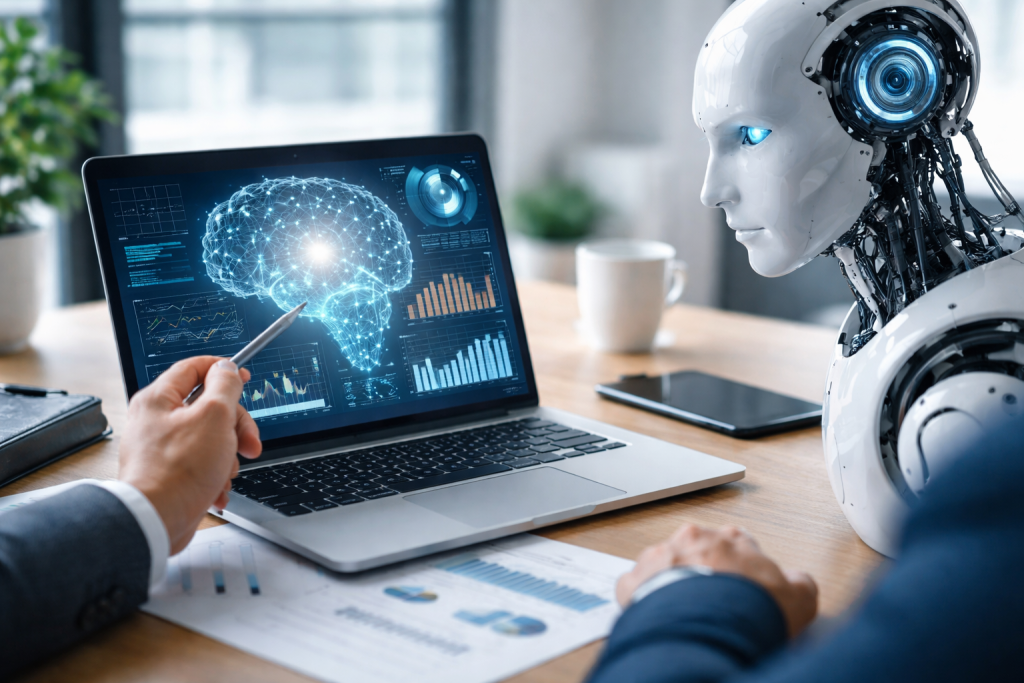
The concept of intelligent machines dates back centuries, appearing in ancient myths and philosophical discussions. However, the formal discipline of AI emerged in the mid-20th century.
Contents
- 0.1 Early Foundations and Foundational Thinkers
- 0.2 AI Winters and Resurgence
- 0.3 Components of Human Cognition
- 0.4 The Role of Consciousness and Emotion
- 0.5 Computational vs. Biological Foundations
- 0.6 Learning Paradigms
- 0.7 Creativity and Common Sense Reasoning
- 0.8 Enhancing Decision-Making and Problem Solving
- 0.9 Automating Repetitive Tasks
- 0.10 Expanding Access to Knowledge and Education
- 0.11 Bias and Fairness
- 0.12 Job Displacement and the Future of Work
- 0.13 Autonomy, Control, and Accountability
- 1 FAQs
Early Foundations and Foundational Thinkers
In the 1940s and 1950s, pioneers like Alan Turing laid the theoretical groundwork for AI. In his 1950 paper “Computing Machinery and Intelligence,” Turing suggested the “Imitation Game,” which later became known as the Turing Test, as a way to measure machine intelligence. This test suggested that if a machine could converse in a way indistinguishable from a human, it possessed intelligence. John McCarthy coined the term “artificial intelligence” in 1956, and Marvin Minsky and Claude Shannon were also crucial figures in the early development of the field. These early researchers were optimistic about AI’s potential, envisioning machines that could rapidly solve complex problems.
AI Winters and Resurgence
The initial enthusiasm for AI was tempered by significant challenges. Funding declined during periods now known as “AI winters” (roughly 1974-1980 and 1987-1993), as researchers failed to meet ambitious predictions. Limitations in computing power, data availability, and the complexity of common-sense reasoning proved substantial hurdles. But in the early 21st century, AI research and development picked up again because algorithms got better, computers got faster, and digital data grew at an exponential rate. This era saw breakthroughs in machine learning, particularly deep learning, which propelled AI into numerous practical applications.
Human intellect encompasses a broad range of cognitive faculties that enable us to navigate and interact with the world. Unlike AI, which operates based on programmed rules and data, human intellect is organic and multifaceted.
Components of Human Cognition
Human cognition includes processes such as perception, attention, memory, language, and reasoning. Perception allows us to interpret sensory information from our environment. Attention enables us to focus on relevant stimuli while filtering out distractions. Memory stores and retrieves information, forming the basis of learning and experience. Language provides a system for communication and thought. Reasoning involves the ability to form judgments, make decisions, and solve problems through logical inference. These components work in concert, forming a complex web of cognitive functions.
The Role of Consciousness and Emotion
Beyond cognitive functions, human intellect is deeply intertwined with consciousness and emotion. Consciousness, while not fully understood, refers to our awareness of ourselves and our surroundings. Emotions, such as joy, fear, and sadness, influence our decisions, motivations, and social interactions. These subjective experiences are central to the human condition and contribute to our unique form of intelligence. While AI can simulate emotions or process emotional cues, it does not currently possess subjective emotional experiences in the way humans do.
While both AI and human intellect demonstrate problem-solving capabilities, their underlying mechanisms and fundamental nature differ significantly.
Computational vs. Biological Foundations
AI systems are built upon computational models and algorithms, processing information through silicon and software. They excel at tasks requiring repetitive calculations, vast data analysis, and adherence to predefined rules. Think of AI as a powerful calculator with an expanding set of instructions. Human intellect, on the other hand, is a product of biological evolution, relying on the complex neural networks of the brain. Our intelligence is organic, adaptable, and deeply integrated with our physical bodies and experiences. It is a living, evolving system.
Learning Paradigms
AI learns primarily through data. Machine learning algorithms identify patterns in large datasets to improve performance on specific tasks. This technique is akin to a student learning a language by analyzing millions of sentences. Deep learning, a subset of machine learning, employs artificial neural networks structured in layers, allowing for the extraction of increasingly abstract features from data. Contrast this scenario with human learning, which is a more holistic process. Humans learn not only from data and direct instruction but also from experience, social interaction, intuition, and abstract reasoning. We can derive general principles from limited examples and transfer knowledge across disparate domains, something AI currently struggles with.
Creativity and Common Sense Reasoning
Creativity in humans often involves divergent thinking, the ability to generate novel ideas and solutions by breaking established patterns. While AI can produce creative outputs, such as generating art or music, these are often based on learned patterns and interpolations from existing data. The true originality, the flash of insight that defines human creativity, remains largely elusive for AI. Similarly, common sense reasoning, the intuitive understanding of the world that humans acquire effortlessly, is a major challenge for AI. Machines often lack the implicit knowledge about typical interactions, physical properties, and social cues that humans use to navigate everyday life.
Instead of viewing AI as a competitor to human intellect, it is more productive to consider its potential as an augmentation tool. AI can extend human capabilities in numerous ways.
Enhancing Decision-Making and Problem Solving
AI systems can process and analyze vast quantities of data far more quickly and thoroughly than humans. This capability can be harnessed to assist in complex decision-making, offering insights and predictive analytics that might escape human observation. In fields like medicine, AI can analyze patient data to suggest diagnoses or treatment plans. In finance, AI can identify market trends and flag potential risks. These tools do not replace human judgment but rather provide a richer informational landscape from which to make informed choices. Think of AI as a powerful microscope that reveals details that are invisible to the human eye, enabling the human scientist to make more informed decisions.
Automating Repetitive Tasks
Many human jobs involve repetitive, mundane, or dangerous tasks. AI and robotics are increasingly taking over these roles, freeing human workers to focus on more creative, strategic, or interpersonal work. This automation can lead to increased efficiency and safety in industries ranging from manufacturing to logistics. The goal here is not to eliminate human work but to elevate it, allowing humans to engage in activities that leverage our unique cognitive strengths, such as complex problem-solving, emotional intelligence, and innovation.
Expanding Access to Knowledge and Education
AI-powered educational tools can personalize learning experiences, adapting to individual student paces and learning styles. Language translation AI breaks down communication barriers, making knowledge accessible across linguistic divides. Search engines, powered by AI, allow us to access information almost instantly. These applications democratize knowledge, empowering individuals to learn and grow in ways previously unimaginable. Imagine AI as an infinitely patient tutor or a universal translator, facilitating understanding for all.
As AI becomes more integrated into society, important ethical and societal considerations emerge. We, as a society, must proactively address these challenges.
Bias and Fairness
AI systems learn from the data they are fed. If historical data contains biases, the AI will perpetuate and potentially amplify them. This can lead to unfair or discriminatory outcomes in areas such as hiring, loan applications, or criminal justice. Ensuring fairness requires careful data curation, algorithm design, and ongoing auditing of AI systems. It is our responsibility to build AI that reflects our aspirational values, not just our historical shortcomings.
Job Displacement and the Future of Work
The automation driven by AI may lead to significant shifts in the job market, potentially displacing workers in certain sectors. Proactive measures, such as retraining programs, education reform, and exploring new economic models, will be crucial to mitigate the negative impacts and ensure a just transition for the workforce. The challenge is not to stop technological progress but to manage its social consequences responsibly.
Autonomy, Control, and Accountability
As AI systems become more capable and autonomous, questions of control and accountability arise. Who is responsible when an autonomous AI makes a mistake or causes harm? How much autonomy should we grant to AI in critical systems? These are not trivial questions. Establishing clear ethical guidelines, regulatory frameworks, and mechanisms for accountability will be essential to manage the risks associated with increasingly sophisticated AI. We must define the boundaries within which AI operates, ensuring it remains a tool in our hands rather than an unguided force.
In conclusion, artificial intelligence represents a powerful new frontier in human endeavor. While distinct from human intellect in its fundamental nature, it offers profound opportunities to augment our capabilities, solve complex problems, and improve lives. However, its development and deployment demand careful consideration of ethical implications and societal impact. The future lies not in replacing human intellect, but in fostering a symbiotic relationship where AI serves as a powerful extension of our cognitive abilities, pushing the boundaries of what is possible.
FAQs
What is artificial intelligence (AI)?
Artificial intelligence (AI) refers to the simulation of human intelligence in machines that are programmed to think and act like humans. This includes tasks such as learning, problem-solving, and decision-making.
How does AI differ from human intellect?
AI is designed to mimic human intelligence, but it is fundamentally different from human intellect. While AI can perform specific tasks with outstanding accuracy and efficiency, it lacks the emotional and intuitive capabilities of human intellect.
What are the potential applications of AI in various industries?
AI has the ability to change various industries, including healthcare, finance, transportation, and manufacturing. It can be used for tasks such as diagnosing diseases, predicting market trends, optimizing logistics, and automating production processes.
What are the ethical considerations surrounding AI development and use?
Ethical considerations surrounding AI include issues related to privacy, bias, job displacement, and the potential for misuse. It is important to ensure that AI is developed and used in a responsible and ethical manner to minimize negative impacts on society.
How can AI and human intellect work together for mutual benefit?
AI and human intellect can complement each other in various ways. While AI can handle repetitive and data-intensive tasks, humans can provide creativity, empathy, and ethical judgment. By working together, AI and human intellect can achieve greater efficiency and innovation.

AI & Secure is dedicated to helping readers understand artificial intelligence, digital security, and responsible technology use. Through clear guides and insights, the goal is to make AI easy to understand, secure to use, and accessible for everyone.