
Demystifying AI Automation and Robots: Exploring Their Unique Roles in the Future of Work
Contents
- 1 Demystifying AI Automation and Robots
- 1.1 Artificial Intelligence: The Brains Behind the Operation
- 1.2 Robotics: The Physical Embodiment
- 1.3 From Industrial Automation to Intelligent Systems
- 1.4 The Rise of Collaborative Robots (Cobots)
- 1.5 AI in Service and Analytical Roles
- 1.6 Manufacturing and Logistics: Enhanced Efficiency
- 1.7 Healthcare: Precision and Accessibility
- 1.8 Retail and Customer Service: Personalized Experiences
- 1.9 The Emergence of New Job Categories
- 1.10 Benefits: Productivity, Efficiency, and Innovation
- 1.11 Challenges: Job Displacement and Skill Gaps
- 1.12 Ethical Considerations and Bias
- 1.13 Security and Data Privacy
- 1.14 Human-AI Collaboration: Augmenting Capabilities
- 1.15 Fostering a Culture of Continuous Learning
- 1.16 The Role of Education and Policy
- 1.17 Innovation Through Human-AI Symbiosis
- 2 FAQs
- 2.1 1. What is the role of AI automation and robots in the future of work?
- 2.2 2. What impact will AI automation and robots have on the workforce?
- 2.3 3. What are the benefits and challenges of integrating AI automation and robots in the workforce?
- 2.4 4. How are AI automation and robots reshaping industries and job roles?
- 2.5 5. What concerns and misconceptions surround AI automation and robots in the future of work?
Demystifying AI Automation and Robots
The modern workplace is increasingly integrating AI automation and robots. This transformation, driven by advancements in artificial intelligence and robotics, is prompting a reevaluation of how work is performed, the skills required, and the overall structure of industries. Understanding these technologies, their current applications, and their projected impact is becoming essential for individuals and organizations alike. This article aims to demystify AI automation and robots, explore their unique roles, and examine their profound influence on the future of work.
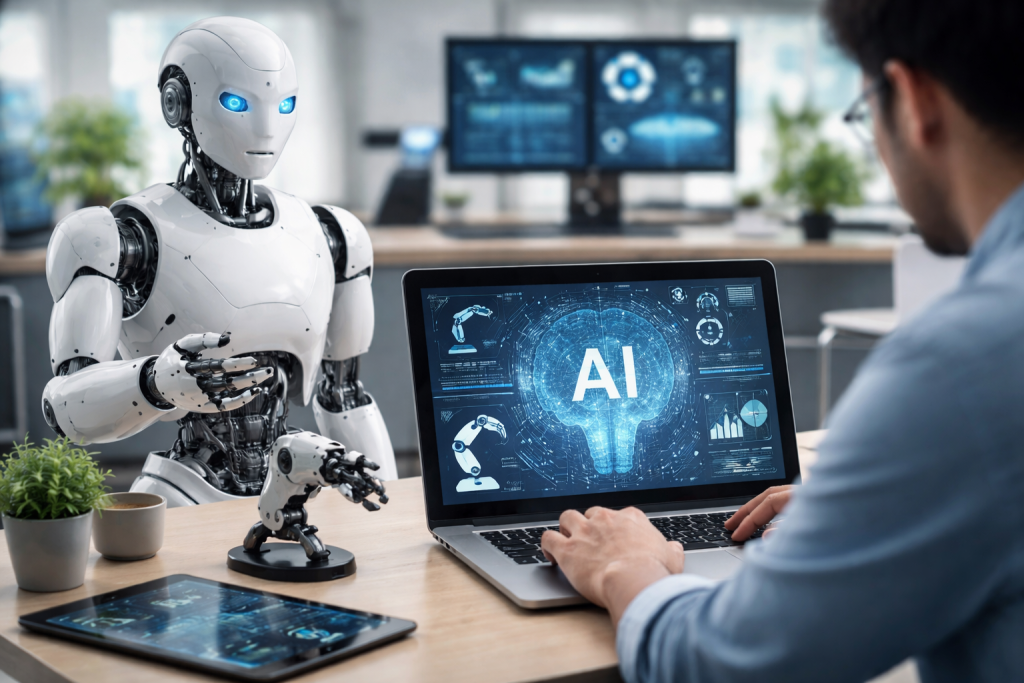
The discussion surrounding AI and robots frequently evokes visions of a robotic future or extensive job displacement. While these technologies undeniably bring change, their implementation is a more nuanced process, akin to fitting new gears into an existing clockwork mechanism. The goal is not necessarily to replace entirely but to augment, optimize, and, at times, create entirely new avenues of operation.
AI automation and robotics are distinct but often overlapping fields. Understanding their individual capabilities and how they work in tandem is key to grasping their impact.
Artificial Intelligence: The Brains Behind the Operation
Artificial intelligence (AI) refers to the development of computer systems that can perform tasks typically requiring human intelligence. These tasks include learning, problem-solving, decision-making, perception, and language understanding. AI is not a single entity but a broad category encompassing various approaches and techniques.
Machine Learning and Deep Learning
A significant subset of AI is machine learning (ML), where algorithms learn from data without being explicitly programmed. Deep learning (DL), a further specialization within ML, utilizes artificial neural networks with multiple layers to process complex information. These learning capabilities allow AI systems to identify patterns, make predictions, and refine their performance over time. This type of training is like teaching a child—you show them examples, and they learn to recognize objects or perform actions.
Natural Language Processing (NLP)
Natural Language Processing (NLP) enables computers to understand, interpret, and generate human language. This is what allows AI-powered chatbots to converse, translation software to function, and sentiment analysis tools to gauge public opinion. NLP is the bridge connecting human communication with machine understanding.
Robotics: The Physical Embodiment
Robotics involves the design, construction, operation, and application of robots. A robot is a machine capable of carrying out a complex series of actions automatically, especially one programmable by a computer. Robots can range from simple automated arms on an assembly line to sophisticated humanoid machines.
Types of Robots and Their Applications
Industrial robots, designed for manufacturing environments, have been prevalent for decades, performing repetitive and strenuous tasks. Collaborative robots, or “cobots,” are designed to work alongside humans, sharing physical workspaces and safely assisting with tasks. Service robots, on the other hand, are designed to perform tasks for people or equipment outside of industrial settings, such as in healthcare, logistics, or domestic environments.
The integration of AI and robots into the workplace is not a sudden event but a gradual evolution. Early automation focused on mechanical processes, while the advent of AI has introduced a layer of intelligence and adaptability.
From Industrial Automation to Intelligent Systems
Initial automation efforts were largely mechanical, focused on automating repetitive tasks in manufacturing. Assembly lines, for example, exemplify this early stage. The introduction of computer control systems allowed for more precise and programmable automation. The current wave, however, is characterized by AI-driven automation, which can adapt to changing conditions, learn from experience, and make more sophisticated decisions. This transformation is like moving from a wind-up toy to a self-driving car.
The Rise of Collaborative Robots (Cobots)
Cobots represent a significant shift in human-robot interaction. Unlike traditional industrial robots that were often caged for safety, cobots are designed to work near human workers. They are equipped with sensors and safety features that allow them to stop or slow down when a human enters their workspace, making them ideal for tasks that require a combination of human dexterity and robotic strength or precision. This partnership can lead to improved ergonomics and efficiency.
AI in Service and Analytical Roles
Beyond physical tasks, AI is increasingly taking on roles that were once solely the domain of humans. AI-powered analytics tools can process vast datasets to identify trends, predict outcomes, and optimize business strategies. Customer service chatbots handle inquiries, freeing up human agents for more complex issues. These systems are not merely automating existing processes but are augmenting human decision-making and service delivery.
The revolutionary impact of AI automation and robots is evident in their ability to reshape entire industries and redefine the nature of job roles. This is not simply about replacing jobs but about reassigning tasks and creating new ones.
Manufacturing and Logistics: Enhanced Efficiency
In manufacturing, AI-powered robots are optimizing production lines, improving quality control through automated inspection, and enhancing predictive maintenance. This leads to faster production cycles and reduced waste. In logistics, automated guided vehicles (AGVs) and robotic sorting systems are revolutionizing warehouse operations, moving goods with greater speed and accuracy. This process is like a finely tuned orchestra, where each instrument plays its part in harmony.
Healthcare: Precision and Accessibility
AI is playing an increasingly vital role in healthcare. Diagnostic AI can analyze medical images with remarkable accuracy, aiding physicians in identifying diseases earlier. Robotic surgery systems offer enhanced precision and minimally invasive procedures. Drug discovery and development are also using AI-powered tools to speed up the process of finding new treatments. Furthermore, AI can assist with administrative tasks, freeing up medical professionals to focus on patient care.
Retail and Customer Service: Personalized Experiences
Retail uses AI for inventory management, personalized recommendations, and optimizing pricing strategies. Chatbots and virtual assistants are enhancing customer service by providing instant support and answering frequently asked questions. This allows for a more efficient and tailored customer experience.
The Emergence of New Job Categories
The adoption of AI and robotics not only automates some jobs but also creates new job opportunities. There is a growing demand for AI trainers, robot maintenance technicians, data scientists, AI ethics officers, and professionals who can design, implement, and manage these advanced systems. The landscape of work is shifting, requiring a focus on skills that complement, rather than compete with, AI capabilities.
While the integration of AI automation and robots presents significant advantages, it also poses a unique set of challenges that require proactive resolution.
Benefits: Productivity, Efficiency, and Innovation
The most apparent benefits lie in increased productivity and efficiency. AI and robots can perform tasks faster and more consistently and wear out less than humans. They can operate in environments that are hazardous or undesirable for humans, such as extreme temperatures or dangerous chemical zones. This also opens up opportunities for innovation, allowing businesses to explore new products, services, and operational models that were previously impossible. The ability to analyze vast amounts of data also leads to more informed decision-making.
Challenges: Job Displacement and Skill Gaps
A significant concern is the potential for job displacement. As automation takes over certain tasks, workers whose roles are heavily dependent on them may face unemployment. This illustrates the importance of reskilling and upskilling initiatives to equip the workforce with the abilities needed for the evolving job market. Bridging these skill gaps is paramount to ensuring a just transition.
Ethical Considerations and Bias
AI systems are trained on data, and if that data contains biases, the AI will reflect those biases. This can lead to unfair or discriminatory outcomes in areas like hiring, loan applications, or even criminal justice. Ensuring fairness and transparency in AI algorithms is a complex but essential ethical consideration.
Security and Data Privacy
As AI systems become more interconnected and process more sensitive data, cybersecurity and data privacy become paramount. Protecting these systems from malicious attacks and ensuring the responsible handling of personal information are critical to maintaining trust and safety.
The future of work, shaped by AI automation and robots, is not a dystopian vision but an opportunity for collaboration and enhanced innovation. The key lies in understanding these technologies and strategically integrating them to augment human potential.
Human-AI Collaboration: Augmenting Capabilities
The most promising future involves a symbiotic relationship between humans and AI. AI can handle repetitive, data-intensive, or physically demanding tasks, while humans focus on creativity, critical thinking, complex problem-solving, empathy, and strategic decision-making. This partnership can lead to a more fulfilling and productive work experience. Imagine a skilled craftsperson using advanced AI tools to design and execute their creations with unprecedented precision.
Fostering a Culture of Continuous Learning
In this evolving landscape, a commitment to continuous learning is no longer optional but essential. Individuals and organizations must embrace lifelong learning to adapt to new technologies and acquire new skills. This includes developing digital literacy, understanding AI principles, and cultivating adaptability and resilience.
The Role of Education and Policy
Educational institutions and policymakers have a crucial role to play in preparing the workforce for the future. This involves updating curricula to include relevant technical and soft skills, promoting STEM education, and developing policies that support workers through transitions, such as investing in retraining programs and providing social safety nets.
Innovation Through Human-AI Symbiosis
By leveraging the strengths of both humans and AI, organizations can unlock new levels of innovation. AI can identify patterns and possibilities that humans might miss, while human creativity and intuition can guide AI in novel directions. This collaborative synergy has the potential to drive groundbreaking advancements across all sectors. The future workplace is not about humans versus machines, but about humans and machines working together to achieve more than either could alone. Understanding, adapting, and strategically integrating AI automation and robots will be the defining characteristic of successful organizations and individuals in the years to come.
FAQs
1. What is the role of AI automation and robots in the future of work?
AI automation and robots are expected to play a significant role in the future of work by taking on repetitive and mundane tasks, allowing humans to focus on more complex and creative work. They are also anticipated to enhance productivity and efficiency in various industries.
2. What impact will AI automation and robots have on the workforce?
The integration of AI automation and robots in the workforce is likely to lead to a transformation in job roles and industries. While some tasks may become automated, new opportunities for skill development and job creation are also expected to emerge.
3. What are the benefits and challenges of integrating AI automation and robots in the workforce?
The benefits of integrating AI automation and robots include increased productivity, cost savings, and improved safety in hazardous environments. However, we also need to address challenges such as job displacement, ethical considerations, and the need for retraining and upskilling of workers.
4. How are AI automation and robots reshaping industries and job roles?
AI automation and robots are reshaping industries by streamlining processes, enabling predictive maintenance, and facilitating data-driven decision-making. They are also leading to the creation of new job roles that require skills in managing and collaborating with AI technologies.
5. What concerns and misconceptions surround AI automation and robots in the future of work?
Concerns and misconceptions surrounding AI automation and robots include fears of mass unemployment, ethical implications of AI decision-making, and the potential for job polarization. It is important to address these concerns through informed discussions and proactive measures to ensure a smooth transition into the future of work.

AI & Secure is dedicated to helping readers understand artificial intelligence, digital security, and responsible technology use. Through clear guides and insights, the goal is to make AI easy to understand, secure to use, and accessible for everyone.